This is Tin, CEO of Open Energy. I want to talk about energy, and why our work with LG Nova matters now more than ever.
LG Nova is the Silicon Valley innovation division of LG. It was an honor to be selected for the first group of companies in their Coalition for Innovation. The Blueprint’s introduction says it perfectly: “We come together not to debate if a clean, equitable, and abundant future is possible—we come together to determine how to make it real, fast.”
This coalition is a strong signal. It means industry leaders see what we see: the coming collision between two energy demands, AI and EVs.
This year at Davos, Microsoft CEO Satya Nadella set a new rule for the global economy. He said, “GDP growth in any place will be directly correlated to the cost of energy in using AI.” You can read his statement here.
This changes the conversation. Leadership in the next economy will depend on one thing: access to massive, affordable, and smart power.
At the same time, we are putting millions of electric vehicles on the road. This shift is led by fleets for logistics and ride hailing, which operate day and night. This year, we will see more autonomous vehicles expanding their services. They do not sleep, and they need energy all the time.
We now face a simple problem. Our current grid cannot handle both demands at once. Picture a major data center drawing full power. Now imagine a million fleet vehicles plugging in at the same time. The system would fail.
This is not a charging problem. It is an energy coordination problem. This is what we solve.
At Open Energy, we build HyperSwap, an AI powered battery swap system for EV fleets. For a logistics company, the benefit is simple: a full battery in under three minutes. No parking. No waiting. The larger benefit is for the grid itself.
HyperSwap stations are not just swap points. They are smart energy buffers. Our AI talks to grid operators. It asks one question: when is the best time to charge?
The grid might say, “Now is bad. Can you wait two hours? We will have more solar power then.” So we wait. We charge when energy is abundant and cheap, not when everyone else needs it.
This also works in reverse. The grid can call on us. In a shortage, an operator can ask, “Can you send stored energy back for one hour?” Our stations can do that. We become a flexible resource.
This two way flow is key. It turns fleet vehicles into a distributed network that supports the grid, instead of straining it.
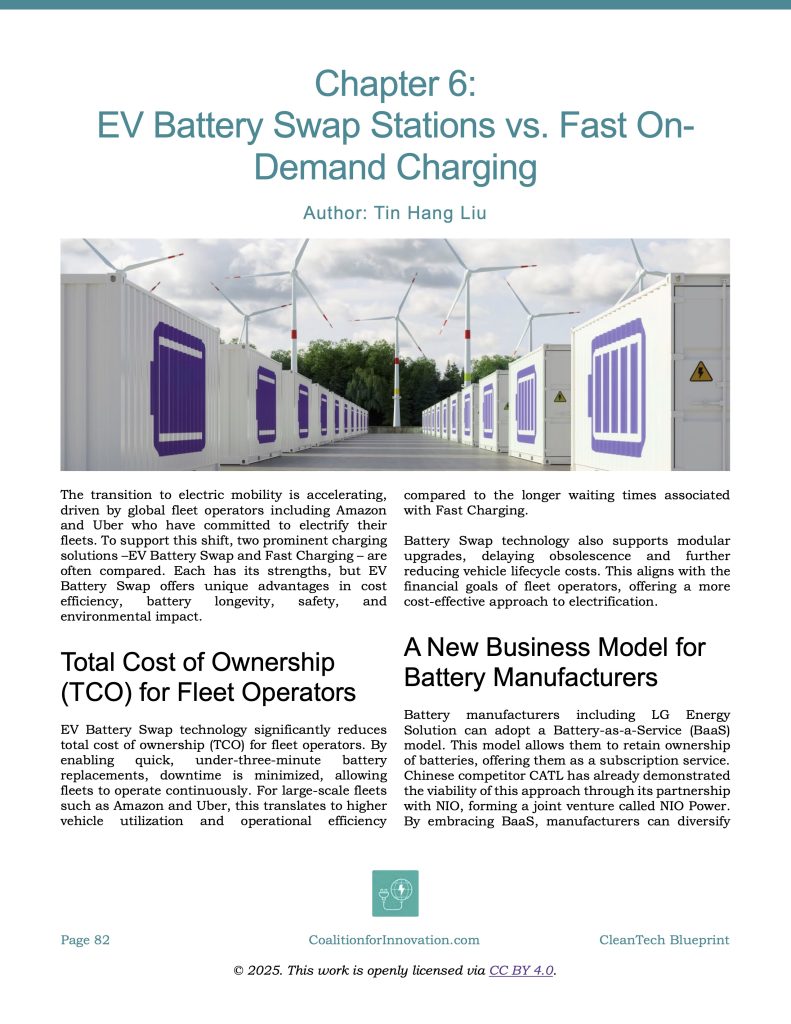
Our work with the Coalition for Innovation by LG Nova shows how powerful this solution is. Our chapter in their CleanTech Blueprint explains why battery swap is the necessary infrastructure for commerce.
- The core purpose is to electrify commercial fleets, where downtime means lost money.
- Swap gives a full charge in under 3 minutes. Fast charging a truck takes 45 to 90 minutes. Fleets can keep moving.
- Fast charging degrades batteries, giving them 300 to 500 life cycles. Our controlled depot charging extends life to 850 to 2,000 cycles. This 3x to 6x improvement is the biggest factor in cutting total cost.
- It enables Battery as a Service. Manufacturers like LG can own and lease batteries. Fleets avoid huge upfront costs and get updated tech.
- Swapping allows for off peak charging using cheaper, greener energy. Stations can also sell stored energy back to the grid.
- The system is built for the future. It can work with new battery types, like solid state or sodium ion, as they emerge.
- We proved this on a 1,400 km route in India. For the Mumbai Delhi freight corridor, swap technology cuts total trip time to about 24 hours. This matches diesel truck efficiency. It is the only method that makes the numbers work for electric freight.
The bottom line is this: for commerce and logistics, battery swap is not just an alternative to charging. It is the economically superior and operationally essential foundation for scalable electrification.
The future of mobility will be run by fleets. These fleets need autonomous energy. A self driving vehicle cannot plug in. It needs a robot to serve it, which is what our station does. More importantly, these fleets must be part of the energy solution.
Our collaboration with LG Nova is about building that solution. It is about making sure the AI revolution and the EV revolution can happen together, without breaking the grid.
You can read the full, public CleanTech Blueprint here. The data tells the story better than I can.
Tin Hang Liu
CEO, Open Energy